The Nail Damage Loop: Why Your Nails Never Get Strong (and How to Break the Cycle)

Last updated:
Affiliate Disclosure:
This article may contain affiliate links. If you purchase through these links, FemmeGlowDaily may earn a small commission at no extra cost to you.
Recommendations are based on research, hands-on testing, and relevance to the topic—not compensation.
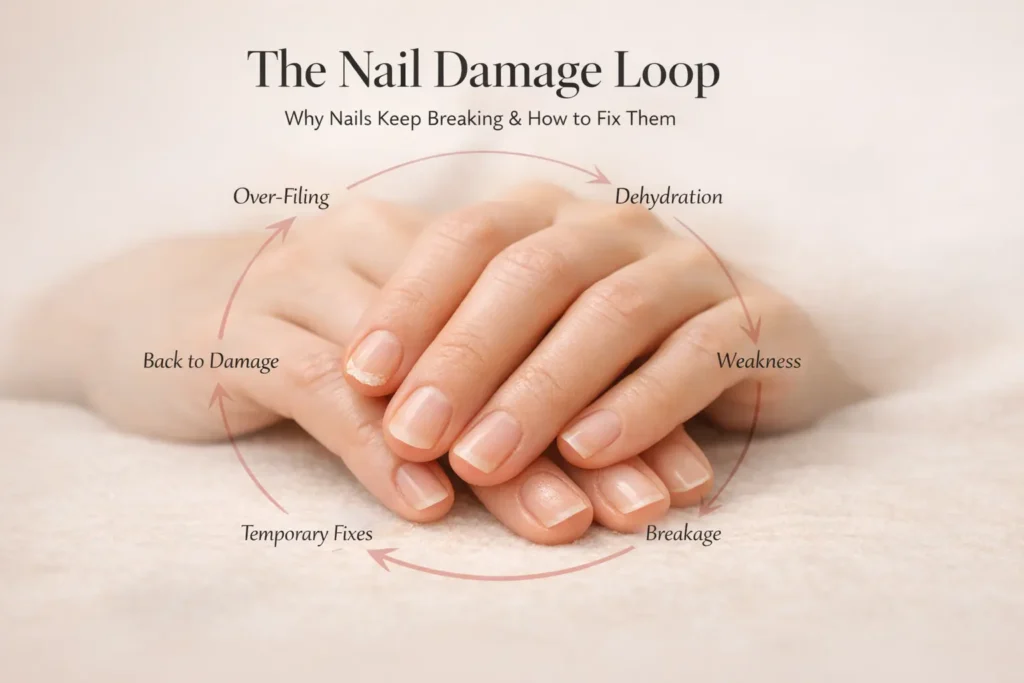
If your nails grow but never seem to get strong, you may be stuck in a cycle where common nail “fixes” actually cause more damage.
This guide breaks down that cycle—called the nail damage loop—and explains how to rebuild nail strength using
realistic, evidence-based care rather than quick cosmetic solutions.
Quick Jump:
1. Why Nails Keep Breaking (Even When You’re “Doing Everything Right”)
If you’re someone whose nails grow but never seem to stay strong, you’re not imagining it.
A lot of people feel like they’re constantly trimming, filing, oiling, and still dealing with breaks,
splits, or peeling edges that just won’t stop.
The frustrating part is that most nail advice makes it feel like the problem is simple —
“just moisturize more” or “use a hardener.”
But in reality, nail breakage is rarely caused by just one thing.
It’s usually the result of repeated small habits that slowly weaken the nail over time.
Some nails snap cleanly. Others peel in thin layers. For some people, the nail bends and tears
before it ever gets long.
These are all different signs, but they often get lumped together under the same vague advice.
And that’s where things start going wrong.
What most people don’t realize is that nail growth and nail strength are two very different things.
Your nails can grow quickly and still be structurally weak.
So even if length is showing up, durability might not be.
Another issue is that many “fixes” are reactive.
A nail breaks, so we harden it.
It peels, so we buff it smooth.
It looks bad, so we cover it with polish or enhancements.
None of these actually address why the nail weakened in the first place.
If you want a deeper breakdown of one of the most common causes,
you can read the full guide here:
why nails keep breaking and what usually triggers it
.
That article focuses specifically on breakage, while this guide looks at the bigger pattern behind it.
In the next section, we’ll step back and look at the full cycle that keeps nails weak —
not just what’s happening on the surface, but how common habits quietly create a loop
that’s hard to escape unless you recognize it.
2. The Nail Damage Loop (The Pattern Most Advice Completely Misses)
Once you step back and really look at what’s happening, nail damage starts to feel less random.
Most people aren’t actually bad at nail care — they’re just repeating the same pattern
without realizing it.
This pattern is what I call the nail damage loop.
It usually starts quietly.
Nails feel a little bendy, maybe they peel at the tips, or they just don’t feel as solid
as they used to.
At this point, nothing looks serious, so it’s easy to brush off.
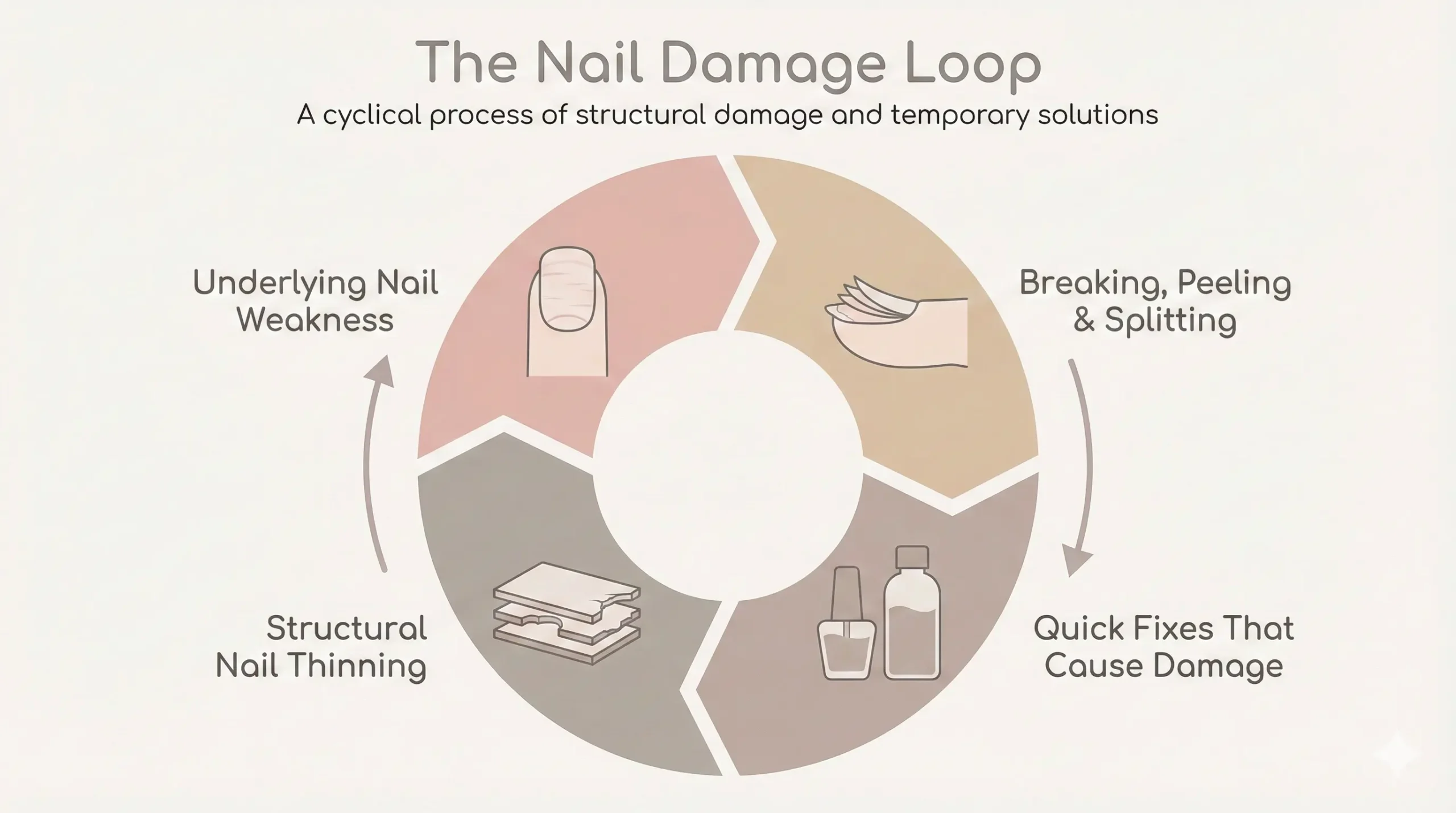 Image credit: FemmeGlowDaily
Then a nail breaks or starts peeling.
That’s usually when people jump into action.
A hardener goes on.
The surface gets buffed smooth.
Acetone shows up more often.
It feels productive, like you’re finally fixing the issue.
The problem is that most of these quick fixes make the nail either more rigid or thinner
than it was before.
The nail might look better for a few days, sometimes even a week,
but underneath, the structure is getting weaker.
Eventually, it breaks again — and the cycle repeats.
What makes this loop so hard to escape is that every step feels logical when you’re inside it.
You’re reacting to what you can see.
But nail damage is cumulative.
The nail remembers what happened weeks ago, even if it looks fine today.
This is also why nail advice can feel confusing or even contradictory.
One source says to harden your nails.
Another says to avoid hardeners completely.
Someone else tells you to stop all products.
Without understanding the loop, it’s impossible to know which advice actually applies to you.
In the next section, we’ll slow things down and figure out
what kind nail damage you’re dealing with.
Brittle nails, peeling nails, and thin nails don’t all fail for the same reason,
even though they’re often treated exactly the same way.
3. Diagnose Your Nail Problem (Not All Nail Damage Is the Same)
One of the biggest reasons nail care advice fails is because most people are treating
every nail problem the same way.
But nails don’t all break or weaken for the same reason.
Before trying to fix anything, it helps to understand what kind of damage you’re actually dealing with.
Take a moment and think about how your nails usually fail.
Do they snap suddenly?
Do thin layers peel off at the tips?
Or do you see vertical splits running down the nail?
These details matter more than most people realize.
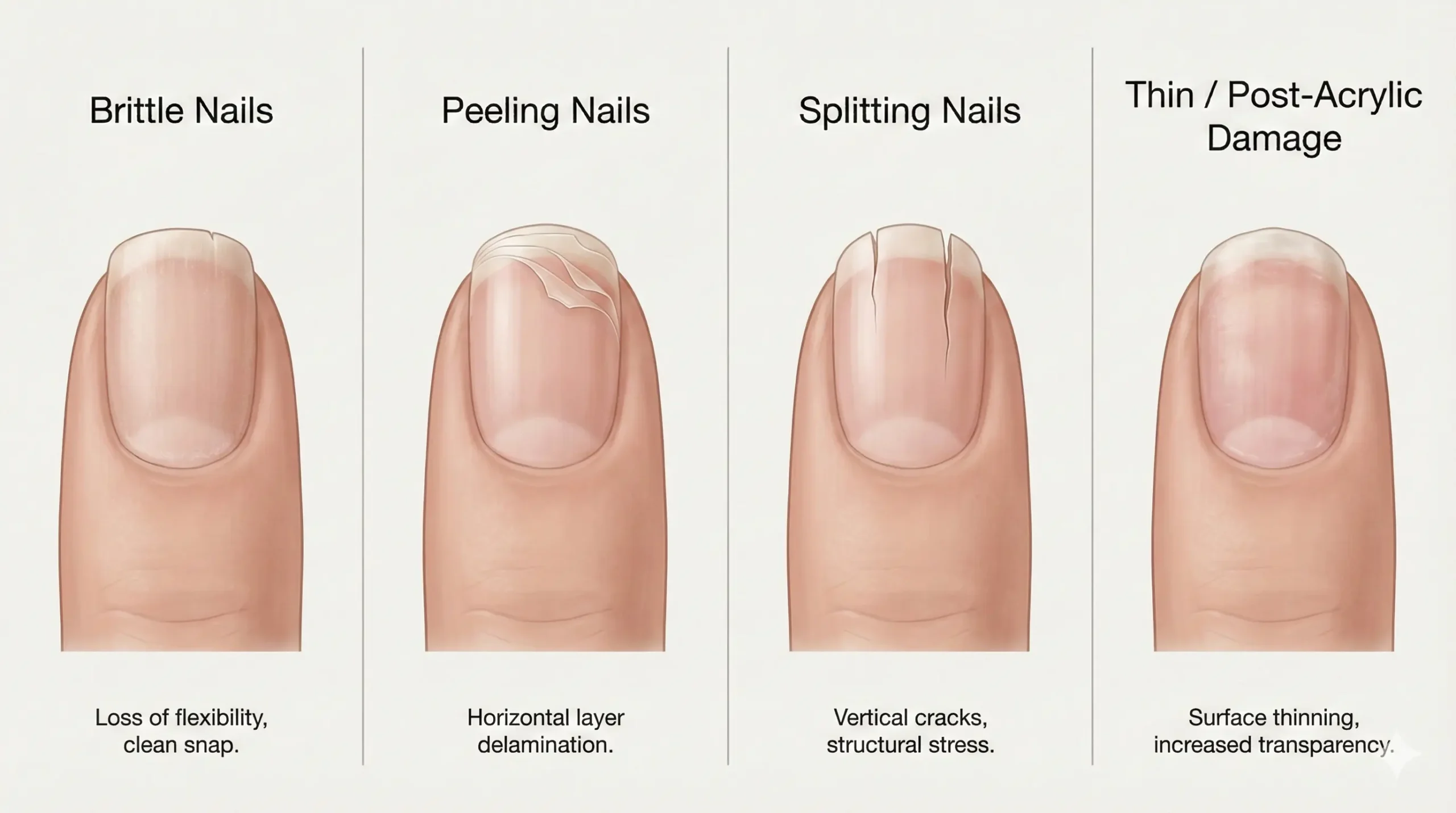 Image credit: FemmeGlowDaily
Brittle nails usually snap cleanly.
They don’t peel much, but they feel stiff and unforgiving.
This often points to a flexibility issue, where the nail can’t bend without breaking.
Peeling nails behave differently.
Instead of snapping, thin layers lift and separate, usually from the free edge.
This is a sign that the layers of the nail plate aren’t holding together properly,
even if the nail doesn’t look damaged at first glance.
Splitting nails tend to crack vertically.
You’ll often see a split start at the tip and slowly travel upward.
This kind of damage is commonly linked to repeated stress at the nail edge,
especially when nails are longer.
Thin or post-acrylic nails feel weak in a different way.
They may look slightly see-through, bend too easily, or feel sore when pressed.
This usually happens after over-filing, frequent removal, or long-term enhancements.
If this sounds familiar, you’re not alone.
A lot of people have more than one type of damage happening at the same time.
That’s why one-size-fits-all advice rarely works.
In the next section, we’ll look beneath the surface and talk about
what’s actually happening inside the nail plate —
because once you understand the structure, the damage patterns start to make a lot more sense.
4. What’s Really Happening Inside the Nail Plate
Nail damage can feel confusing because most of it doesn’t start on the surface.
You can look at your nails and think everything is fine, even while the structure underneath
is slowly weakening.
That’s why understanding what the nail is actually made of matters more than people think.
The nail plate isn’t just one solid piece.
It’s made up of multiple layers that are meant to stay tightly bonded together.
When those layers are healthy, nails feel smooth, flexible, and surprisingly strong.
When they’re compromised, nails may peel, thin out, or break in ways that feel unpredictable.
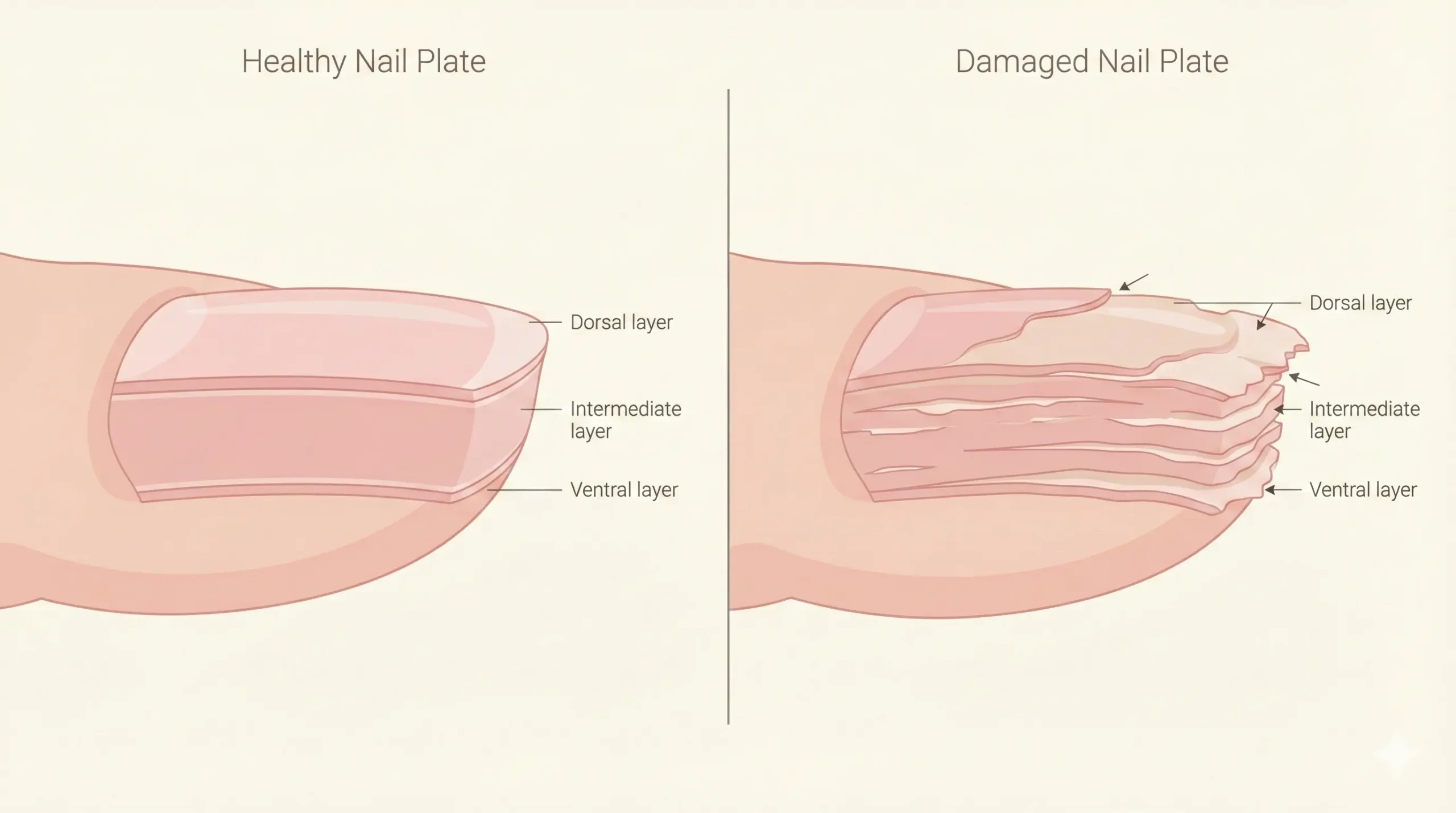 Image credit: FemmeGlowDaily
In a healthy nail, the layers sit flat and compact.
They support each other, which allows the nail to bend slightly without cracking.
This balance between strength and flexibility is what keeps nails from snapping under pressure.
When nails are repeatedly exposed to harsh removal, aggressive filing, or constant dehydration,
the top layers start to thin.
Once that happens, the remaining layers lose protection and begin to separate more easily.
This is when peeling and splitting tend to show up.
Buffing can make nails look smooth for a moment, but it also removes material.
Over time, that loss adds up.
A nail that has been over-filed or over-buffed doesn’t have the same ability to hold itself together,
even if it looks fine immediately after.
This is also why nails often feel worse after certain “treatments.”
The damage isn’t always visible right away.
It shows up later, once the weakened layers can’t handle everyday stress like typing,
washing hands, or light pressure.
Once the nail plate has been thinned or separated, recovery isn’t instant.
The nail has to grow out while being protected from further loss.
That’s why repeated quick fixes tend to delay real improvement instead of speeding it up.
5. Nail Fixes That Actually Cause More Damage
This is the part most people don’t like hearing.
Because almost everyone here is genuinely trying to take better care of their nails.
The problem isn’t effort — it’s that some of the most common “solutions” quietly make things worse.
A nail breaks, so we reach for something stronger.
A peel shows up, so we smooth it out.
It feels responsible, even smart.
But nails don’t respond well to panic-fixing.
They respond to consistency and restraint, which is honestly not very glamorous advice.
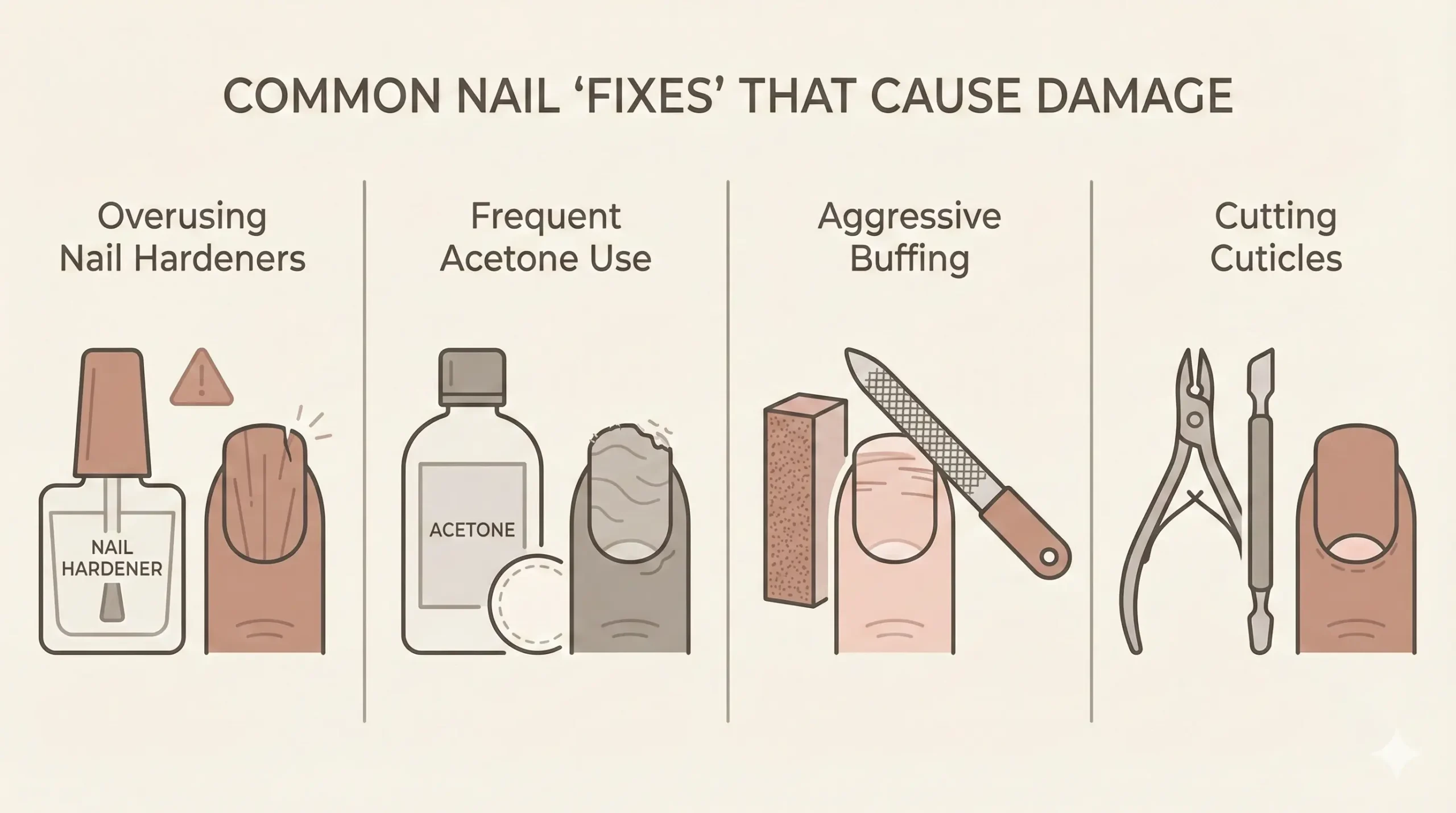 Image credit: FemmeGlowDaily
Overusing nail hardeners is one of the biggest traps.
Hardeners can make nails feel tough, but they often remove flexibility.
A nail that can’t bend will eventually snap.
That’s why some people feel like their nails break worse the longer they use hardeners.
Frequent acetone removal is another sneaky one.
Acetone works fast, which is why people love it.
But repeated exposure strips moisture and lipids from the nail plate.
Over time, nails don’t just look dry — they lose their ability to hold layers together.
Aggressive buffing and filing often feels harmless.
The nail looks smoother, cleaner, more “put together.”
But every pass of a buffer removes material.
When this becomes routine, nails slowly thin out without you noticing right away.
Cutting or scraping cuticles is another habit that’s been normalized for years.
Cuticles aren’t just extra skin.
They help protect the nail matrix.
When they’re constantly removed, the nail is left more exposed to irritation and damage.
None of these habits ruin nails overnight.
That’s why they’re so easy to justify.
The damage builds quietly, until one day your nails just feel weak no matter what you do.
6. Acrylics, Gels & Press-Ons — What Happens and What Actually Helps
I’m going to be honest — many of us have been here.
You walk out of the salon feeling unstoppable,
nails perfect, color gorgeous, confidence boosted.
But somewhere between the salon chair and your morning coffee,
the reality of what was done begins to sink in.
That instant perfection can come at a cost.
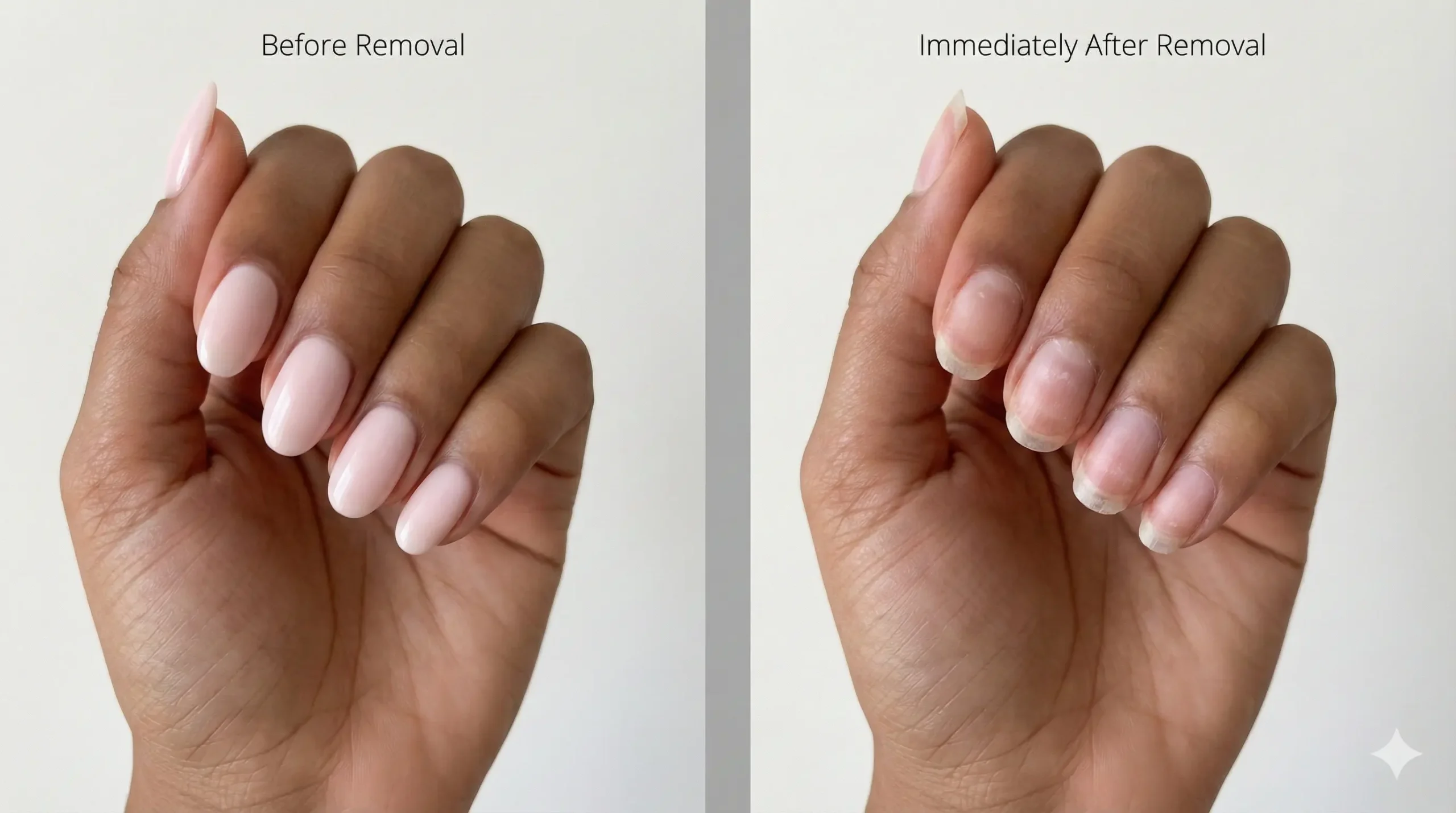 Image credit: FemmeGlowDaily
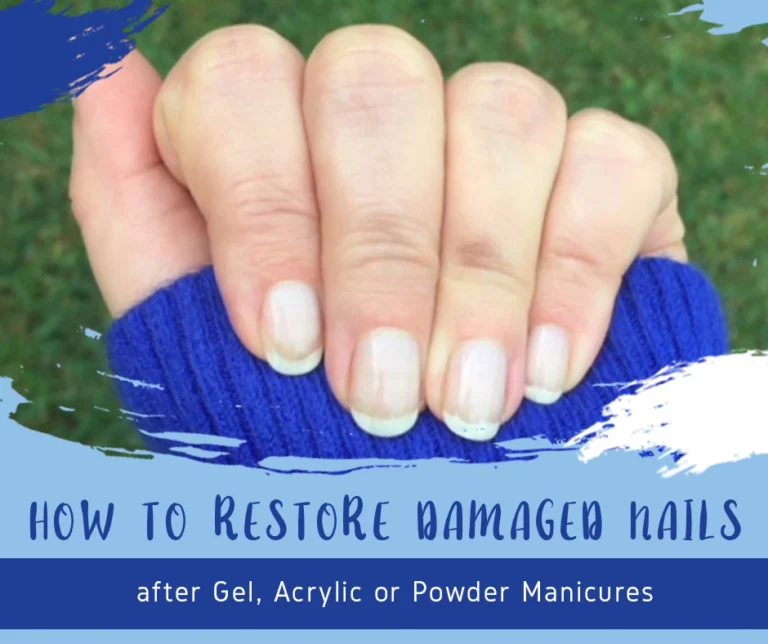
The nails you see immediately after removal don’t always tell the whole story,
but they give a pretty honest first impression.
When acrylics or gels are removed — especially if it’s done multiple times —
it’s common for the natural nail to appear thinner, more translucent, and a little uneven in texture.
It’s not dramatic, but it’s enough to make daily knocks and typing feel a bit more painful than before.
The reason has a lot to do with how enhancements are removed.
Acetone soaks, scraping, filing — each of these plays a role in disrupting
the surface layers we talked about earlier.
Over time, that disruption adds up, and what you *see* becomes what you *feel*:
weaker, softer, more break-prone nails.
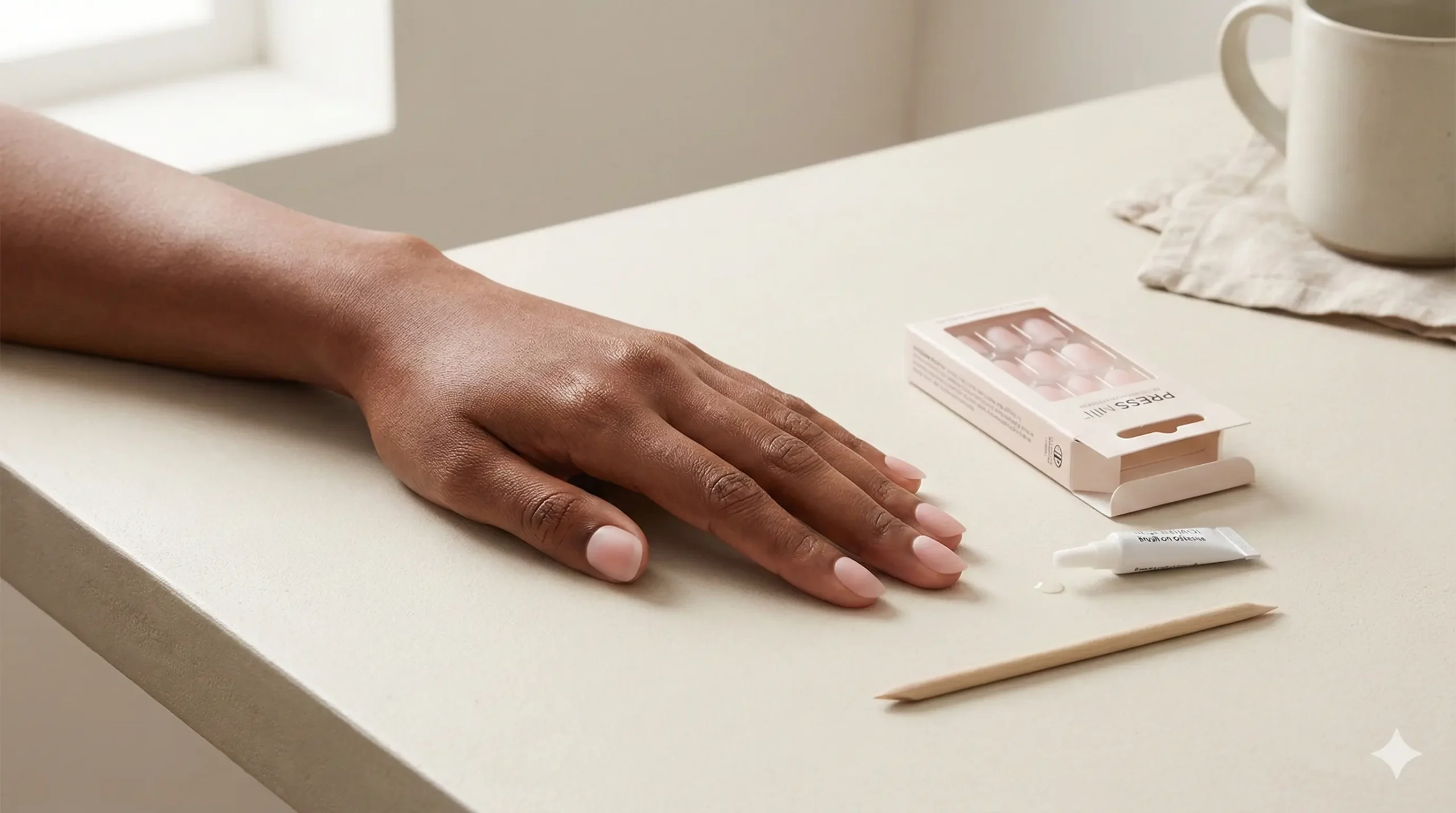 Image credit: FemmeGlowDaily
But here’s the thing:
you don’t have to give up *every* temporary nail look if you love change,
you just have to be more intentional about how you approach it.
That’s where **press-on nails** can be surprisingly helpful.
Used the right way, with minimal glue and no electric tools,
press-ons can give you the fun look you want *without* as much structural trauma.
The key is *how* they’re applied and *how* they’re removed.
When glue isn’t soaked into every inch of the nail edge
and you’re not scraping or grinding them off,
your natural nail plate stays closer to its original integrity.
That translates to fewer breaks, less peeling, and overall stronger nails.
I know this sounds like a lot of small details,
but that’s exactly the point:
nail strength isn’t changed by one dramatic step.
It’s what you *don’t do* — the damage you prevent — that often matters most.
7. How to Break the Nail Damage Loop (Your Best Real-Life Recovery System)
If there’s one thing I’ve learned from talking to readers and seeing hundreds of nail cases,
it’s that recovery doesn’t come from a single trick or one product.
It’s a series of small, intentional habits that — over time — let nails get strong again.
Think of it like training muscles: you don’t lift heavy weights on day one, right?
Nails are similar. They need gentle, consistent care.
What follows isn’t glamorous, and it’s definitely not quick.
But it’s dependable.
These steps are how you *slowly but steadily* break the cycle of damage and finally let your nails
stop spinning in that endless loop of break → fix → break again.
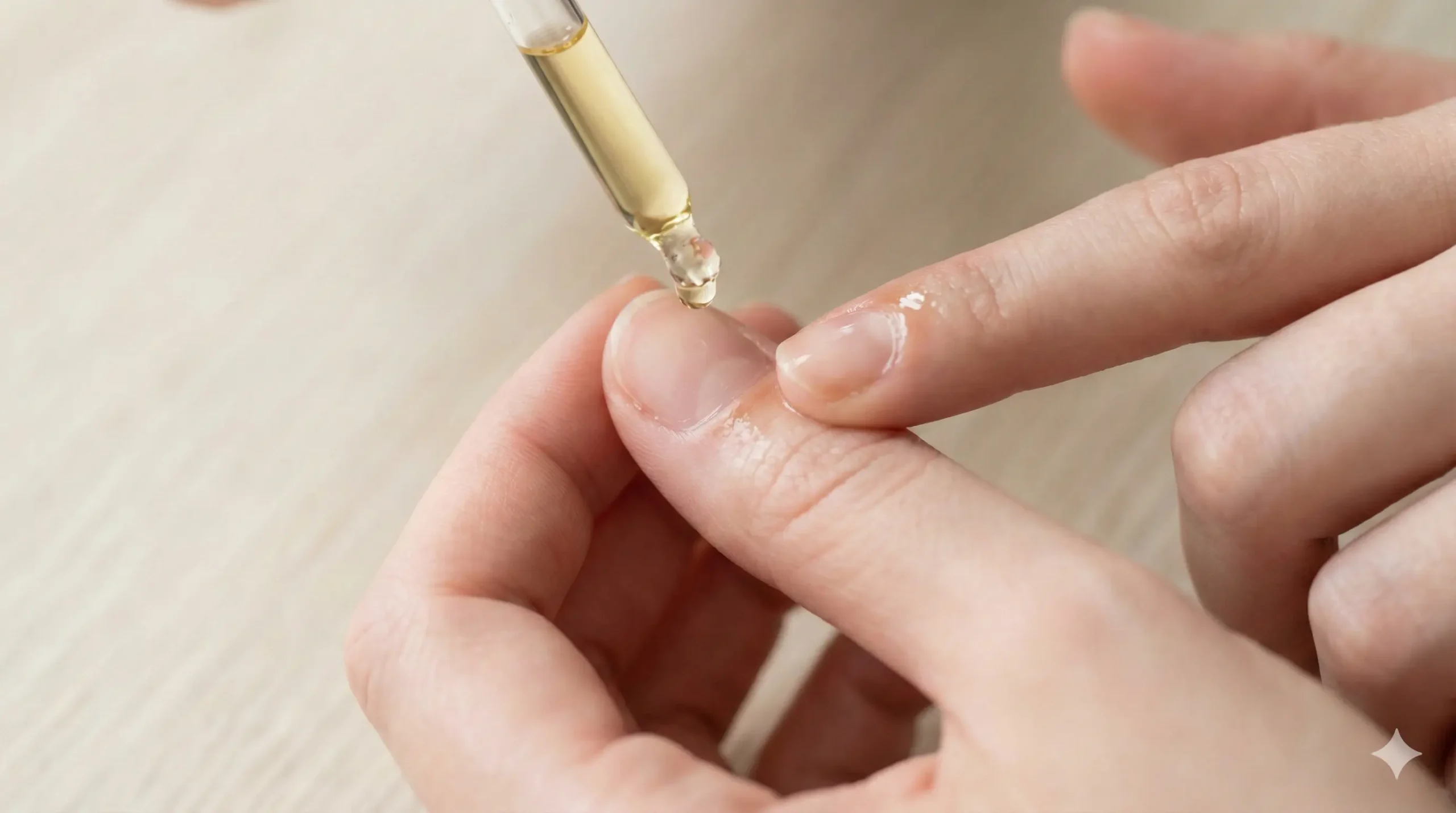 Image credit: FemmeGlowDaily
1. Stop the damage first.
This might sound obvious, but it’s also the hardest part for most people.
That means putting a pause on anything that consistently stresses your nails —
like aggressive filing, constant acetone use, and heavy nail art.
It doesn’t mean never using polish again, but ease up and give your natural nails eye-space.
2. Oil daily — and do it right.
The simple act of applying cuticle oil at the base of the nail really helps.
A lot of people put oil all over the nail plate.
That’s fine, but the real magic happens when you get it close to the cuticle,
where the growth begins. Use it morning and night, and gently massage it in.
3. File gently — one way only.
Say goodbye to aggressive buffers for now.
Instead, pick a fine-grit file and always file in one direction.
Light strokes, slow and smooth — that’s the approach that keeps layers intact.
4. Be choosy with polish and removers.
If you use polish, try to space it out and use gentle removers.
Acetone works fast, but daily use strips away too much moisture.
Non-acetone removers are kinder, but still don’t make this a daily ritual.
5. Add protective breaks.
If you’ve been in beauty mode all the time, your nails need random rest days.
Try a pattern like a week of polish followed by a couple of polish-free days.
These breaks let air and natural oils play their part.
6. Strengthen from the inside (if it makes sense).
Good nutrition matters, and while nails aren’t muscles,
deficiencies can show up as weakness or splitting.
Talk to a clinician if you suspect a systemic issue
(like low iron or vitamin imbalance), because that’s not something topical care can fix on its own.
7. Consistency beats intensity.
You don’t need to overhaul your life overnight.
Small daily choices — a gentle file here, oil there, fewer high-stress habits — add up.
Nails don’t heal in a day, but they *do* respond to steady, undramatic attention.
8. Nail Recovery Timeline — What Real Progress Usually Looks Like
Let’s be honest — if you’re hoping for dramatic overnight improvement,
you might end up frustrated.
Nails take time to grow, and recovery happens in stages.
But it helps a lot if you know what to expect, instead of guessing.
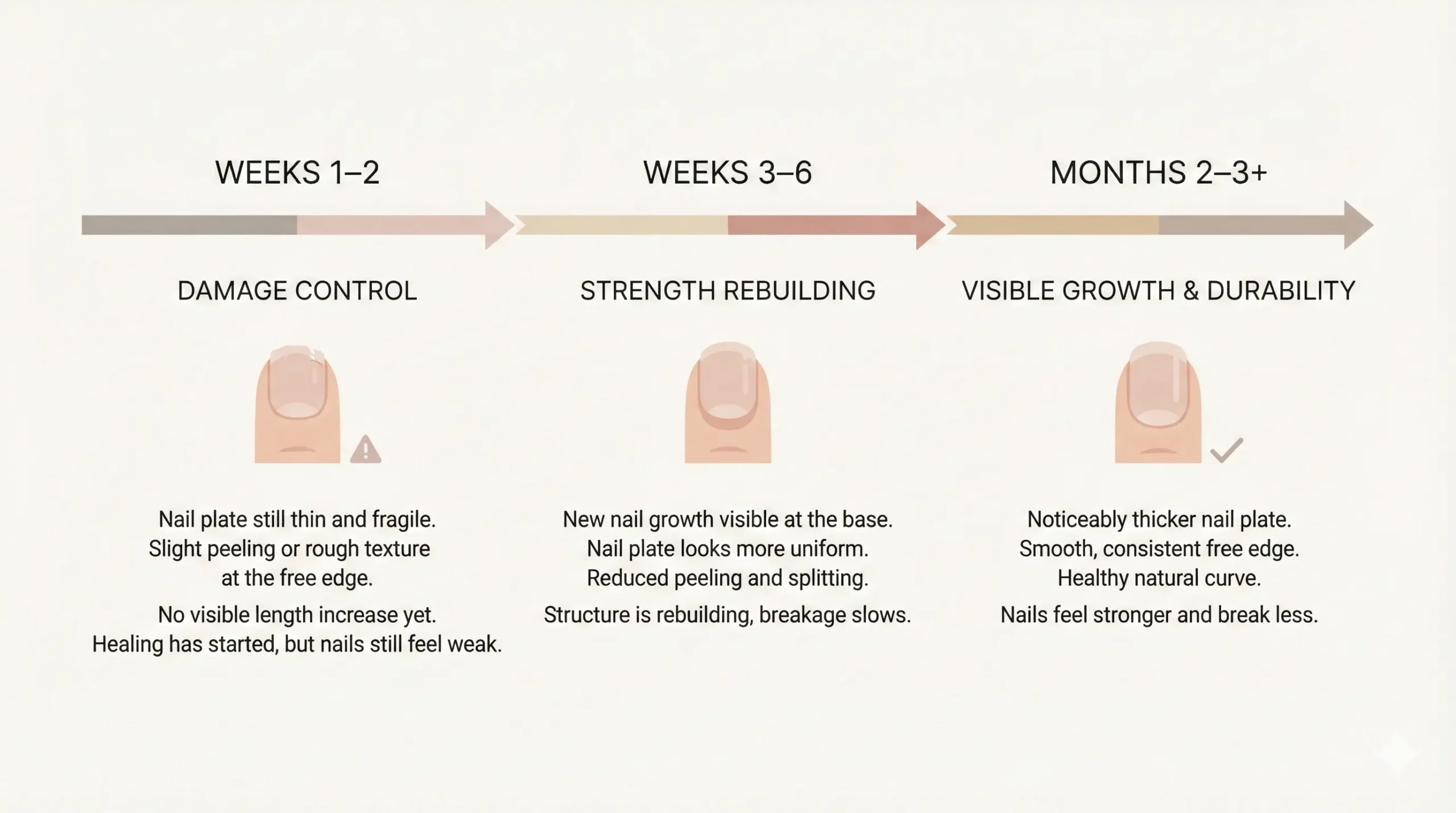 Image credit: FemmeGlowDaily
Most people’s nails don’t suddenly become strong — they change gradually.
If you’ve just stopped the damaging habits we talked about earlier,
you might not notice much in the first week.
That’s normal.
The timeline below breaks things into stages most people actually see.
- Week 1–2 — Damage Control:
This is when you stop hurting your nails more than you help them.
You might see small changes, but honestly, it’s about setting a foundation. - Weeks 3–6 — Strength Rebuilding:
Now you’ll probably start noticing fewer splits and less peeling.
The new growth near the cuticle is often stronger than what’s left at the tip. - Months 2–3 — Real Growth & Durability:
This is when your nails start to feel recognizably stronger.
You can hold off on breakage for longer, and daily tasks feel less threatening.
This timeline isn’t exact for everyone, because genetics, health, and habits all play a role.
But most people who stick with intentional care see consistent improvement
instead of the “two steps forward, three steps back” mess that used to happen.
Healing doesn’t feel like a sprint — it feels more like a slow walk toward a big goal.
And that’s okay. What matters is that each of these stages is a real milestone,
not just a hopeful guess.
9. Nail Recovery Do’s & Don’ts (A Simple Checklist You Can Actually Follow)
At this point, you’ve likely read a bunch of info and maybe started thinking,
“Okay… but what do I *actually do every day*?”
This checklist isn’t fancy, but it’s the kind of advice people remind themselves of
when their nails finally start feeling a little stronger.
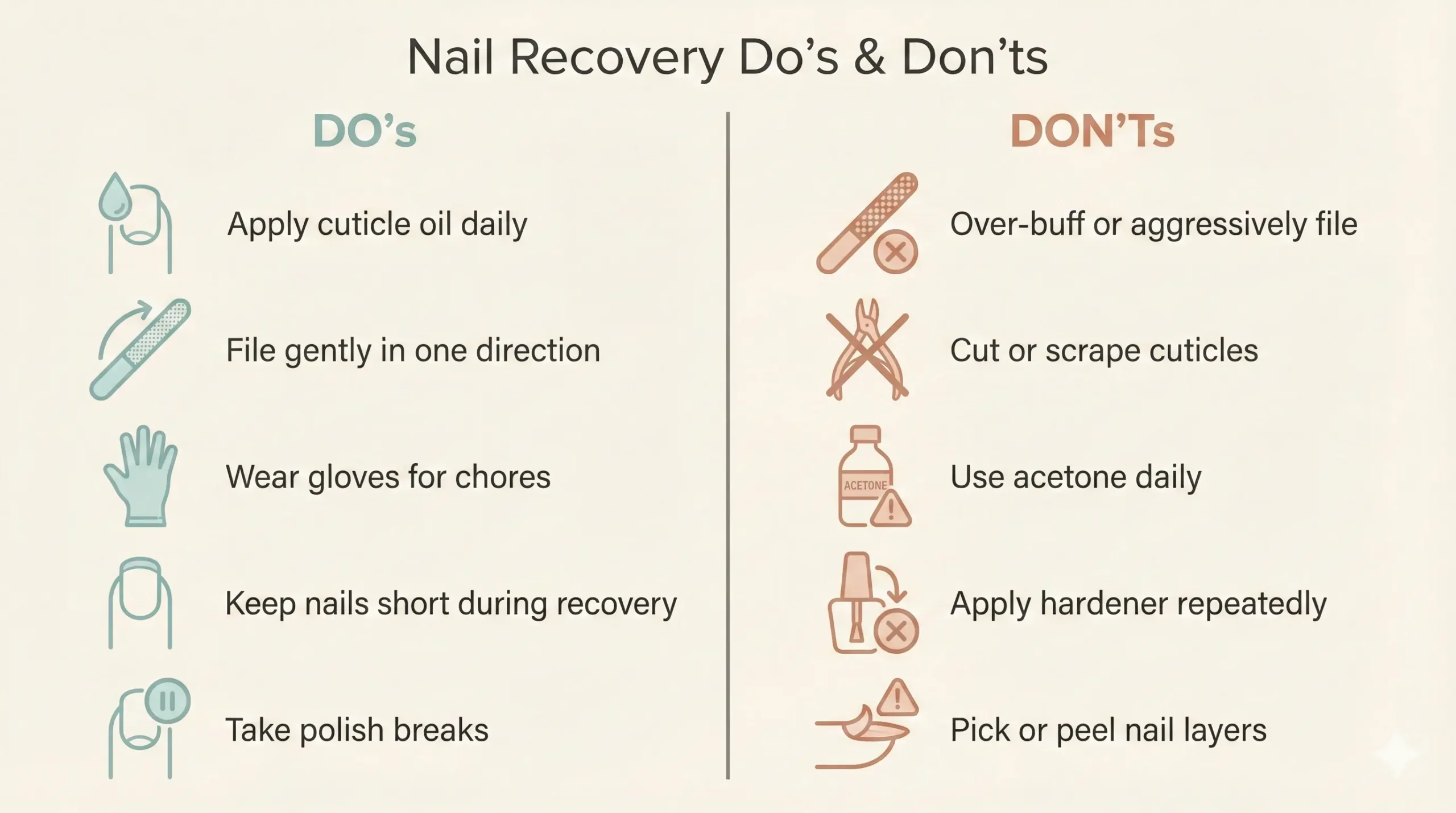 Image credit: FemmeGlowDaily
The idea isn’t perfection — it’s *awareness*.
If you do these do’s more than the don’ts, your nails are *probably* going to behave
better than before.
And if you slip up? Don’t stress — just get back to it tomorrow.
- Do: apply cuticle oil daily — morning and night feels amazing.
- Do: file gently in one direction, not back and forth.
- Do: wear gloves for chores that involve water or cleaning products.
- Do: keep nails shorter while healing — less stress at the edge.
- Do: take intentional breaks from polish now and then.
- Don’t: over-buff or use super abrasive files.
- Don’t: cut or scrape cuticles for a “clean” look.
- Don’t: use acetone remover daily — it’s too drying.
- Don’t: rely on hardeners as a long-term fix.
- Don’t: pick at peeling layers — it usually makes things worse.
That’s really it: few things you do *more* of, and a few habits you do *less* of.
In most cases, consistency is way more powerful than a single miracle product.
10. When Nail Damage Is More Than Just a Nuisance
Most nail issues are harmless and respond to consistent care.
But sometimes the signs are telling you something deeper is going on,
and in those situations, it’s okay — and smart — to bring in a professional.
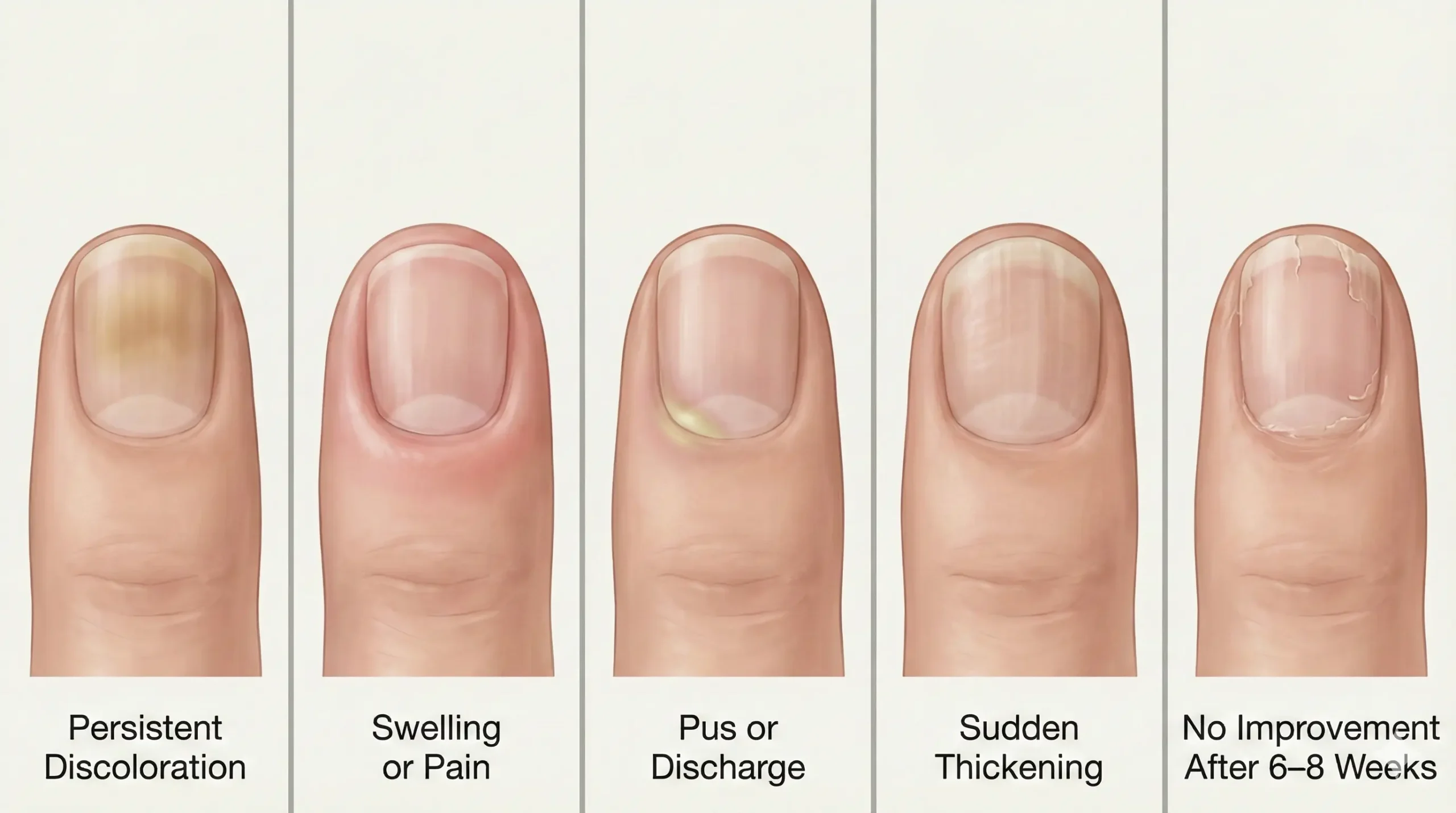 Image credit: FemmeGlowDaily
Just because nails are weak or peeling doesn’t automatically mean you need medical
intervention. A lot of that responds to care and habit changes.
But some signs deserve a closer look, either with a dermatologist, a primary care doctor,
or another qualified clinician.
- Persistent discoloration that doesn’t go away even after cleaning and time.
- Swelling, pain, or heat around the nail fold (especially if it doesn’t calm down).
- Pus or fluid discharge near the nail edge — that’s a signal your body is reacting.
- Sudden thickening or deformity of the nail plate without a clear cause.
- Nail changes that don’t improve after several weeks of consistent care.
These situations don’t always mean something serious, but they do mean
you shouldn’t guess or self-diagnose. A trained professional can check if
there’s an infection, underlying dermatological condition, or something else
that needs targeted treatment.
Asking for help early often makes things easier to manage down the road —
and it’s absolutely okay to do that.
11. Nail Damage & Recovery — Common Questions
Why do my nails keep peeling even when I oil them?
Oiling helps, but it can’t undo damage that’s already there.
Peeling usually means the nail layers have separated,
often from over-filing, frequent polish removal, or long-term dehydration.
Oil supports new growth, but the damaged part still has to grow out.
Are nail hardeners bad for weak nails?
Not always, but they’re easy to overuse.
Hardeners reduce flexibility, which can make weak nails snap more easily.
Many people see better results by focusing on moisture and protection instead.
How long does it really take to grow strong nails?
Most people notice early improvement within a few weeks,
but real strength usually shows up after two to three months.
Nails grow slowly, and steady care matters more than quick fixes.
Should I stop wearing nail polish while my nails heal?
You don’t need to stop completely.
Taking short breaks, spacing out removals, and avoiding constant re-polishing
usually gives nails enough recovery time.
Can nails recover after years of acrylics or gel manicures?
Yes, they can.
Healthier nail growth can replace damaged layers over time,
as long as you reduce repeated stress and give nails a chance to recover.
If there’s one takeaway from this guide, it’s that nail damage rarely comes from one mistake.
It’s usually a series of small habits repeated over time.
Once you recognize the loop and slow things down, nails tend to respond better than people expect.
Strong nails aren’t about doing more — they’re about doing fewer damaging things, more consistently.
Want insider access to nail care product recommendations, recovery tips,
and glow-boosting routines that actually work?

Note: Visual illustrations used in this article were generated using AI-assisted tools for educational and explanatory purposes.